




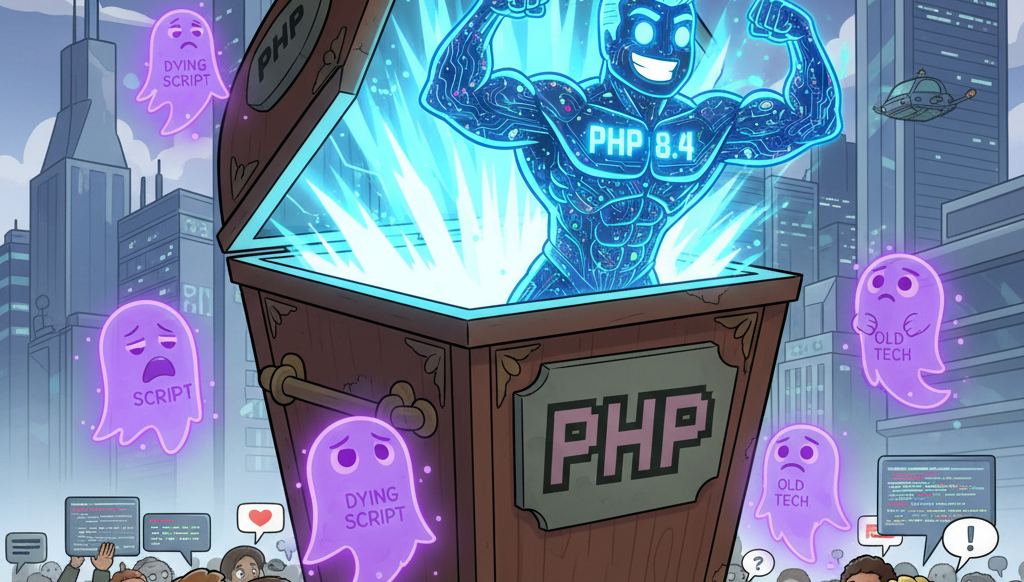
The Silent Giant Powering the Internet
When we talk about PHP fading away, we are ignoring a colossal, undeniable truth: PHP powers over 70% of all websites with a known server-side language.
Think about that for a second. That’s not just a large slice of the pie; it’s the vast majority of the internet. How?
- WordPress: This is the single biggest factor. WordPress, which runs on PHP, powers over 40% of all websites on Earth—from small personal blogs to massive corporate sites. Trying to kill PHP is like trying to shut down WordPress; it’s practically impossible at this scale.
- Enterprise and Stability: While ‘legacy’ sometimes sounds like an insult, in business it means mission-critical and dependable. Countless corporations, including giants like Facebook and Wikipedia, have deep roots in PHP. Migrating away from these massive, stable codebases, which handle everything from e-commerce to internal systems, is often too costly, too risky, and simply unnecessary when the language is actively improving.
This Isn’t Your Grandfather’s PHP
The negative perception of PHP often stems from outdated experiences with its older versions (pre-PHP 7). Sure, PHP used to be slower, clunky, and had some truly wild coding practices floating around.
But the modern PHP ecosystem has evolved beautifully:
- Speed and Performance: With the release of PHP 8 and its subsequent versions (like PHP 8.4), performance has seen massive improvements, including the introduction of Just-In-Time (JIT) compilation. It’s now genuinely fast, competing aggressively with other high-performance server languages like Python and Go.
- Modern Frameworks: Frameworks like Laravel and Symfony have completely modernized the language, bringing elegance, structure, and professional development standards. They make building large, secure, and scalable applications a joy, enforcing best practices like Object-Oriented Programming (OOP) and proper separation of concerns.
- Stronger Code Integrity: Modern PHP has embraced features like static analysis tools (e.g., PHPStan) that catch errors before runtime, making the code much more robust and easy to organize (US spelling). This pushes PHP closer to the reliability of compiled languages.
The Verdict: Evolving, Not Expiring
Is PHP the default choice for every single new highly specialized system, where perhaps a language like Rust or Go offers a tiny edge in raw computing power? Maybe not.
But for the vast world of web development—building content management systems, e-commerce stores, custom APIs, and backend services—PHP is not just surviving; it’s thriving and actively evolving. The community, the extensive documentation (US spelling), and the continued release of faster, more professional versions cement its place.
So, the next time you hear someone declare “PHP is dead,” smile, and remember that you’re standing on ground powered by a quiet giant. PHP isn’t going anywhere. It’s too big, too reliable, and too deeply entrenched in the digital landscape to fade away. It’s simply becoming a better, faster, and more professional language every year.